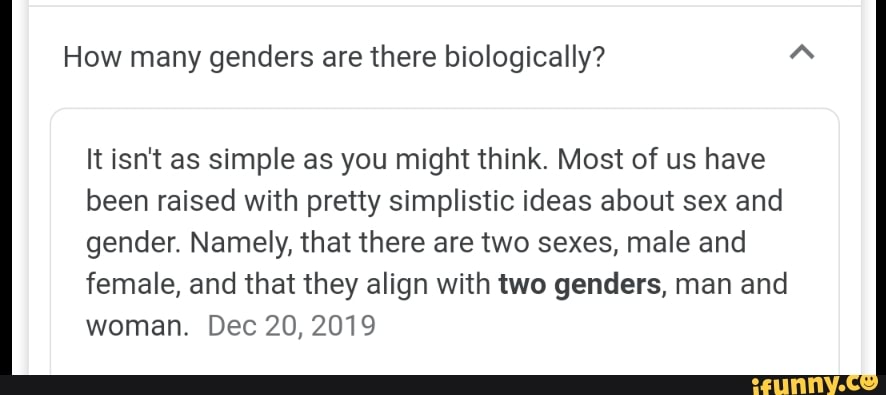
Gender is an intricate tapestry woven into the fabric of human existence, one that eludes simplistic categorization. The question “how many genders are there biologically?” elicits varied responses, reflecting an amalgamation of scientific inquiry and cultural interpretation. This exploration not only delves into biological considerations but also embraces a broader anthropological perspective, particularly through the lens of cultural relativism. As we navigate this discourse, we must acknowledge that the understanding of gender is far from monolithic; it is a dynamic construct influenced by both biological factors and sociocultural contexts.
At the biological level, the concept of sex is frequently conflated with gender. Traditionally, sex has been understood as a binary system: male and female, typically based on chromosomal and reproductive differences. Most individuals possess either XX or XY chromosomes, which traditionally correspond to female and male sexes, respectively. However, this binary classification does not encapsulate the complexities inherent in human biology. Intersex individuals, who may possess characteristics of both sexes or variations in their chromosomal structure, demonstrate that biological sex exists on a spectrum rather than a fixed binary. Some might assert that these biological nuances are merely anomalies; others argue that they signify a broader spectrum of human diversity.
The reductionist view of gender as strictly tied to biological sex falls short when confronted with the diverse expressions of gender identity found across cultures and historical periods. Many cultures have recognized and revered non-binary and gender-fluid identities long before contemporary understandings emerged. For instance, some Indigenous cultures in North America recognize Two-Spirit people, who embody both masculine and feminine qualities. Similarly, South Asian hijras and Samoa’s fa’afafine embody intricate gender roles that contradict Western notions of a binary gender framework. These cultural acknowledgments of gender variance challenge the notion that gender is solely a product of biology.
To comprehend the biological aspects of gender thoroughly, one must incorporate the understanding of hormonal influences. Hormonal differences can significantly affect gender expression and identity. For example, testosterone and estrogen levels influence physical attributes and can have psychological effects on individuals, potentially affecting their gender identity and expression. Research into the role of hormones, particularly in the prenatal environment, suggests that they can shape the brain’s architecture, leading to divergent gender identities. This biological foundation presents a compelling argument for the existence of more than just two genders.
Thus, the limitations of a binary perspective become even more apparent when considering the socio-cultural implications of gender. The construction of gender has evolved alongside sociopolitical changes, with societal norms and expectations increasingly interrogated and challenged. Feminist theory, queer theory, and intersectionality frameworks have all contributed to a nuanced understanding of gender. Those frameworks emphasize that gender cannot be understood in isolation from cultural, historical, and power dynamics. The socio-historical context informs how individuals express their gender and how societies categorize them.
Moreover, cultural relativism prompts an examination of how different societies define and categorize gender. Cultures do not exist in a vacuum; they are influenced by economic, political, ecological, and social conditions. This tenet of cultural relativism underscores that classifications of gender are not universally applicable but are instead contingent upon particular cultural contexts. This perspective fosters a recognition of the multiplicity of gender identities and expressions, suggesting that a single biological foundation cannot adequately account for the rich diversity observed globally.
The fascination with the complexity of gender stems from the intersection of biology and culture, where scientific understanding cannot fully articulate the lived experiences and identities that individuals embody. By confronting the reductive binaries that have long dominated discourse around gender, one opens the door to a more inclusive and integrative dialogue. This discourse requires an appreciation for the individual’s experience, grounded in both biological essence and cultural significance.
Furthermore, embracing this complexity fosters empathy and respect across varying gender identities. As societies progress in their understanding of gender, there is a growing awareness that recognizing and affirming diverse gender identities plays a crucial role in social equity. The advocacy for inclusivity—whether in language, policy, or societal norms—reflects a fundamental shift in recognizing the validity of all gender identities. This shift is not merely a sociopolitical trend; it is an acknowledgment of the intricate interplay between our biological heritage and cultural narratives.
In conclusion, the inquiry into the biological aspects of gender is deeply intertwined with cultural relativism, necessitating a sophisticated understanding that transcends simplistic binaries. Acknowledging the existence of intersex individuals, various gender identities across cultures, and the influence of hormones on gender expression reveals an expansive landscape that is not defined merely by biology but is enriched by cultural context. This dialogue emphasizes the need for ongoing study and discourse, as the complexities of gender continue to evolve in our global society. Ultimately, the journey toward understanding the myriad forms of gender is not merely an academic endeavor but a necessary pathway towards a more equitable and inclusive world.