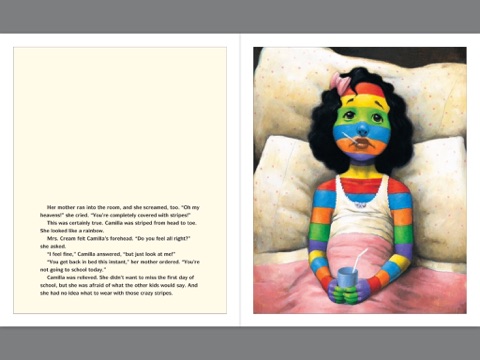
A Bad Case of Stripes, authored by David Shannon, emerges as a compelling narrative that transcends the boundaries of conventional children’s literature. At its core, the narrative presents a profound exploration of identity, conformity, and the quintessential human struggle for self-acceptance. Through its whimsical storytelling and vivid illustrations, the book illuminates the broader themes of cultural relativism, underscoring the significance of embracing one’s individuality within a societal context.
One of the most striking aspects of A Bad Case of Stripes is the titular ailment experienced by the protagonist, Camilla Cream. As she grapples with a bizarre transformation leading to her body being enveloped in an array of multicolored stripes, the metaphor becomes emblematic of societal pressures and expectations. Camilla’s stripes symbolize the multifaceted identities that individuals often possess and the conflicts that arise when societal norms clash with personal authenticity. This phenomenon mirrors the cultural relativist viewpoint, which postulates that individual identities must be understood within their specific cultural contexts. In this case, Camilla is compelled to contort her sense of self to meet the arbitrary standards set by her peers and society.
The book lays bare the inherent tensions between individualism and collectivism. Through a colorful yet chaotic lens, Shannon deftly portrays the relentless pursuit of societal approval that pervades contemporary culture. As Camilla repeatedly alters her appearance to align with the demands of those around her—evident as she oscillates between polka dots, plaid, and even a zebra pattern—the reader is reminded of the sacrifices many individuals make in order to assimilate. This conflict evokes the notion of cultural hegemony, wherein dominant cultural groups dictate the norms and values that others feel compelled to adopt.
The motivation behind Camilla’s transformations serves as a poignant reminder of how societal constructs can stifle genuine self-expression. Each unforeseen alteration reveals the disconnect between her authentic self and the façades she dons to appease others. The irony is palpable; the more she attempts to conform, the more she becomes ensnared in a cycle of dissatisfaction and discontent. This allegorical representation resonates deeply with audiences familiar with the pressures of societal expectations—an experience that transcends age and cultural backgrounds.
A central tenet of cultural relativism is the acceptance of diversity in expressions of identity. In the case of A Bad Case of Stripes, the narrative ultimately advocates for the importance of self-acceptance and authenticity. By the story’s conclusion, when Camilla finally embraces her uniqueness and permits her stripes to exist without fear of judgment, readers are left with a powerful testament to the liberating potential of cultural self-assertion. Camilla’s journey towards self-discovery and acceptance serves as a beacon of hope for individuals grappling with similar issues of identity.
Moreover, Shannon’s illustrative style further amplifies the narrative’s themes. The flamboyant visuals mirror the chaos of Camilla’s experience, effectively engaging readers and enriching their understanding of her internal conflicts. The use of exaggerated colors and forms evokes a sense of wonder, inviting readers to appreciate the beauty inherent in diversity. Such representations challenge conventional notions of beauty and normalcy, encouraging a broader acceptance of variations within identity. This is a core principle of cultural relativism—acknowledging that there is no singular standard by which to measure human worth.
As the plot unfolds, the reactions of Camilla’s peers to her transformation offer valuable insights into the complexities of social dynamics. The cacophony of opinions reflects the often harsh realities of conformity. Camilla’s experience resonates with the idea that societal validation can often come at the expense of personal integrity. Many individuals have encountered similar experiences, grappling with feelings of alienation when failing to conform to established norms. The ridicule and pressure she endures is a poignant reminder of the societal forces that often dictate conformity, catalyzing the journey of many to understand the importance of cultural relativism in accepting the varied tapestry of human experience.
The culmination of the story, wherein Camilla ultimately embraces her stripes—an act of defiance against her previous conformity—serves as a powerful metaphor for personal autonomy. By recognizing the unique beauty in her identity, she transcends societal expectations, embracing a rich tapestry of individuality that is celebrated rather than ridiculed. This metamorphosis exemplifies the duality of identity—where personal authenticity can flourish even in a milieu of cultural expectations, a theme that is central to the discourse on individualism versus collectivism.
A Bad Case of Stripes is not merely a children’s book; it is a discursive exploration of the relationship between identity and culture. Its rich allegorical framework encourages readers to reflect on their own experiences with acceptance, conformity, and the often-turbulent pursuit of self-identity. The narrative eloquently posits that while societal pressures may attempt to dictate our identities, true liberation lies in the acceptance and celebration of one’s inherent uniqueness. In a world saturated with external influences that seek to mold individuals into predefined shapes, the work champions an essential truth: the most profound strength lies in being unapologetically oneself.
In summary, A Bad Case of Stripes by David Shannon offers a nuanced exploration of identity within the framework of cultural relativism. Through its enchanting narrative and vivid illustrations, the story urges readers to challenge societal norms and embrace the multifaceted nature of self. It serves as a resonant reminder that authenticity is not merely an ideal to strive for but a vital component of the human experience. Just as Camilla learns to love her stripes, so too can we all embark on a journey toward embracing the unique tapestries that define us.