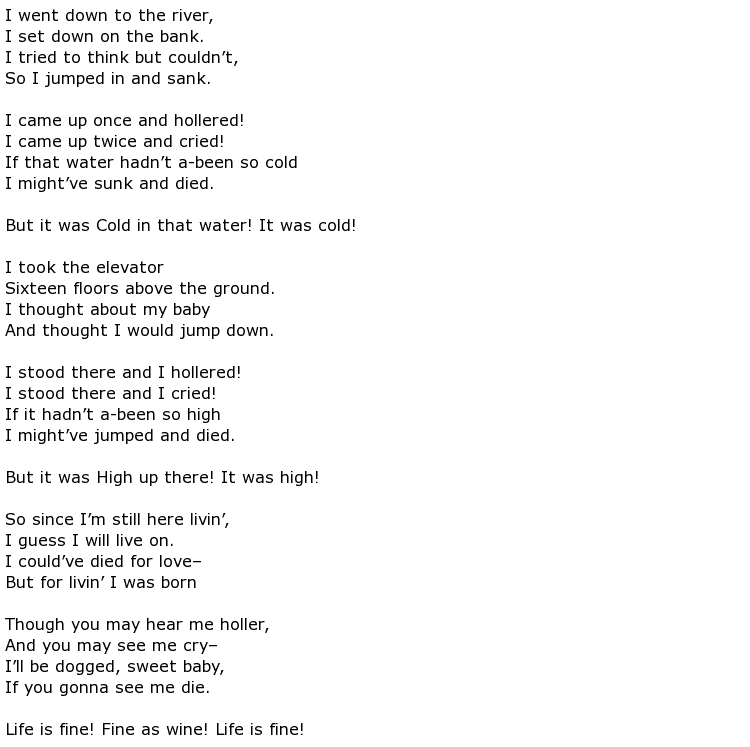
African American poetry has long served as a powerful medium through which to explore the multifaceted experiences of life, struggle, and triumph. Throughout history, poets of African descent have chronicled their inner journeys, revealing the socio-political landscapes that shape their narratives. These verses often embody themes of resilience, hope, and the quest for identity while encapsulating the collective struggles of a people facing systemic oppression. This exploration delves into the works that exemplify this rich tapestry of emotion, offering a lens through which one might gain insights into the broader human experience.
The roots of African American poetry can be traced to the Diaspora, where oral traditions flourished as a means of storytelling and cultural preservation. Enslaved Africans expressed their experiences through spirituals, work songs, and ballads. Notably, forbearers like Phyllis Wheatley laid the groundwork for later poets, demonstrating that even in a context fraught with adversity, the human spirit can find expression. Wheatley’s poignant reflections on her own condition as a slave, endowed her verses with both beauty and gravitas, highlighting the paradox of bondage and intellectual clarity.
The transition into the 20th century sparkled new liturgical endeavors as the Harlem Renaissance ignited a cultural renaissance. Here, poets such as Langston Hughes navigated the intersection of racial identity and personal aspiration, embodying the ethos of the movement. Through poems like *“Mother to Son,”* Hughes articulates the struggle against the backdrop of life’s persistent adversities. The metaphor of the staircase powerfully conveys the notion that life is replete with challenges, yet it is the endeavor to persevere that defines a person’s journey. Hughes inspires readers to recognize the arduous climb as integral to the human experience of triumph.
Amidst the struggles of the 1960s Civil Rights Movement, poets began to employ their craft in more direct sociopolitical commentary. Gwendolyn Brooks emerges as a pivotal figure in this narrative landscape. Her poem *“We Real Cool”* encapsulates the youthful exuberance juxtaposed with the awareness of societal limitations. Through rhythmic repetition, Brooks foregrounds the theme of defiance, yet simultaneously evokes a sense of impending tragedy. Readers are compelled to ponder not only the celebration of life but the ramifications of choices made in a world laden with systemic obstacles.
The thematic relevance of struggle inherits complexities as contemporary poets contribute diverse perspectives. The 21st century heralded voices like Claudia Rankine, whose works challenge conventional boundaries of race, identity, and personal trauma. In *“Citizen: An American Lyric,”* Rankine explores the nuances of everyday racism through vignettes that convey the often invisible struggles faced by African Americans. The text transcends mere poetry, operating as a fusion of poetry and political essay. Here, the triumph lies not just in individual resilience but also in the shared act of witnessing, fostering empathy and understanding.
Furthermore, the voices of spoken word artists such as Amanda Gorman demonstrate the ascent of poetry as a form of activism. Gorman’s *“The Hill We Climb”* stands as a testament to the hope that persists amidst national strife. The poem brilliantly articulates the notion of collective struggle and the power of unity in envisioning a brighter future. By invoking historical references, Gorman empowers her listeners with a narrative steeped in both realism and aspiration. The triumph encapsulated in her delivery prompts audiences to reconsider their agency in the ongoing narrative of American life.
Moreover, the phenomenon of diasporic cultural exchanges further enriches the poetic landscape. Poets like Ocean Vuong articulate the universality of struggle while maintaining a distinctively personal lens. Vietnamese American, yet interwoven with African American influences, Vuong’s work underscores the transcendence of struggle beyond racial confines. Through nuanced imagery and evocative language, Vuong’s exploration of love, loss, and identity underscores the collaborative nature of these artistic expressions, urging readers to embrace the shared elements of the human saga.
The legacies of African American poets extend beyond the confines of poetry itself, weaving into cultural dialogues across various art forms. Music, visual arts, and literature draw upon the emotive power found within these poetic traditions, infusing narratives of struggle and triumph into broader cultural contexts. The luminary figures that dot the landscape of African American poetry invite us to reflect on the intangible threads that connect individual experiences to collective histories.
The exploration of African American poetry reveals a profound tapestry of life struggles and triumphs, crafted by artists who wield their pens with the intention to inspire, provoke, and heal. Each poem represents not only the voice of an individual but also becomes emblematic of a community grappling with identity, resistance, and hope. Such works challenge us to confront our preconceptions and cultivate an understanding of resilience that transcends the boundaries of race and identity.
In seeking to engage with these themes, one can glean insights that resonate across different contexts, fostering a greater appreciation for the rich legacy of African American literature. The poems provide not merely a reflection of struggles faced but also a beacon of hope that triumph is attainable, weaving a timeless narrative that encourages introspection and empathy in the shared human experience. As one reflects on the oeuvre of African American poets, it becomes clear that their contributions are not confined to historical contexts but remain vibrantly relevant in navigating contemporary sociopolitical landscapes.