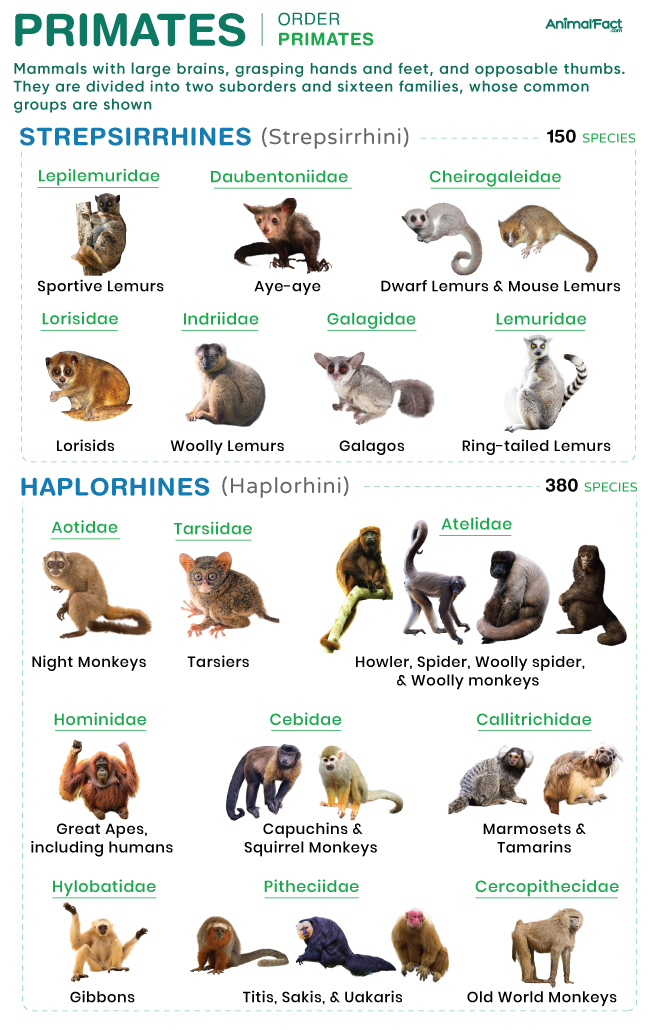
Are all mammals primates? This question may provoke a chuckle or a bemused shake of the head, yet acumen into the taxonomic hierarchy of the animal kingdom unveils answers that are both informative and intricate. To understand why the assertion that all mammals might be classified under the primate umbrella is erroneous, one must embark on a detailed examination of mammalian classification, taxonomy, and the distinctive characteristics that delineate primates from other mammalian orders.
The mammals, a diverse class of animals characterized by features such as hair or fur and mammary glands, are categorized into three primary groups: monotremes, marsupials, and eutherians (or placental mammals). Each of these categories exhibits unique reproductive strategies and evolutionary adaptations. Monotremes, such as the platypus and echidna, are remarkable for their egg-laying reproductive method, a divergence from the more prevalent live birth seen in marsupials and eutherians. Marsupials, including kangaroos and koalas, are distinguished by their unusual reproductive system where the young continue developing in a pouch after a short gestation period. Lastly, eutherians encompass a vast array of familiar mammals, from rodents to elephants, utilizing a complex placental structure for gestation.
Primates, often revered for their cognitive complexity, intricate social structures, and dexterous appendages, belong to a separate taxonomic category within the mammal class. The order Primates is further bifurcated into two clades: Strepsirrhini and Haplorhini. Strepsirrhines encompass lemurs, lorises, and galagos, while haplorhines include tarsiers, monkeys, apes, and humans. One pivotal characteristic of primates is their reliance on visual acuity rather than olfactory senses, an adaptation that reflects their predominantly arboreal lifestyle.
As one traverses the intricate web of classifications, it becomes apparent that primates share a common ancestry with other mammal groups, yet they diverge in critical anatomical and behavioral traits. This divergence prompts an immediate inquiry: If all mammals are not primates, what then sets these remarkable creatures apart? The key lies in understanding both morphological features and evolutionary history.
One significant differentiator is the structure of the primate brain. Compared to other mammals, primates possess larger and more complex brains relative to their body size. This encephalization index has been linked to various factors, including social complexities, problem-solving abilities, and adaptability to varying environments. The neocortex, responsible for higher-order brain functions, is particularly well-developed in primates, underscoring their cognitive sophistication.
Additionally, the opposable thumbs, or in some cases, toes found in many primates allow for precise grip and manipulation. This trait is conspicuously absent in many other mammalian orders, relegating species such as cetaceans and ungulates to perform tasks underpinned by the anatomical constraints of their own evolutionary paths. The evolutionary journey of primates has endowed them with tools for environmental adaptation that are markedly distinct from those found in other mammalian taxa.
Another critical factor is diet. Primates exhibit a varied diet primarily composed of fruits, leaves, and insects, displaying adaptations such as specialized teeth for their foraging habits. In contrast, carnivorous mammals like felids exhibit sharp, retractable claws and a distinct dental morphology suited for predation, highlighting a great evolutionary divergence. In grasping dietary preferences and anatomical distinctions, one not only delineates primates from other mammals but appreciates the vast spectrum of mammalian evolution.
Moreover, social behavior—a salient trait among primates—constitutes yet another distinguishing characteristic. Primates are known for their intricate social structures, which often include hierarchical relationships, cooperative rearing of offspring, and complex communication methods. Socially structured creatures such as wolves exhibit their own forms of social order, yet the cognitive underpinnings and behavioral patterns diverge significantly from those of primates. This necessitates a recognition that while all primates are mammals, the reverse holds no validity.
It is essential to confront the mythology that arises from misunderstandings about mammalian classifications. Common misconceptions may suggest that characteristics such as intelligence, opposable thumbs, or social complexity should define an entire class of animals. However, these traits, while quintessential to primates, do not encapsulate the richness and diversity of all mammals.
Engaging in the exploration of mammalian classification, one encounters a rich tapestry that reflects adaptation and survival over vast epochs. It becomes imperative to appreciate the subtleties that define each order, wherein primates possess enchanting and unique anatomical and behavioral characteristics that enable them to thrive in their niches throughout the world.
Thus, in addressing the provocative question of whether all mammals are primates, the answer resoundingly affirms our understanding of taxonomy and evolutionary biology: No, not all mammals are primates. The attributes of this incisive group serve not only as a testament to evolutionary potential but also as a reminder of the remarkable diversity inherent in the mammalian lineage. As we continue to delve into the depths of evolutionary science, the distinctions among species illuminate the complexity of life on Earth, showcasing that every lineage—primate or otherwise—has a story worth telling.