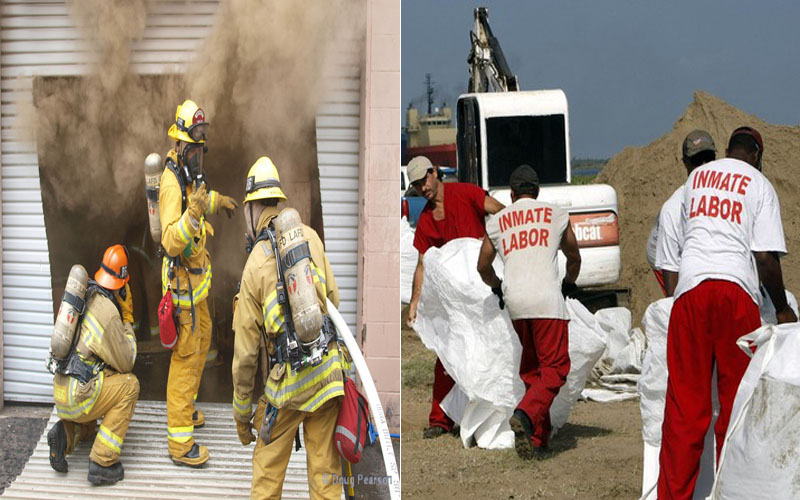
In the vast tapestry of America’s criminal justice system, a curious phenomenon emerges that warrants closer examination: the existence of inmate firefighters. Are these men and women truly heroes donned in prison garb, or is this arrangement a poignant illustration of cultural relativism in action? The juxtaposition of incarceration juxtaposed with community service evokes a multitude of questions regarding societal values, equity, and the function of rehabilitation within the penal framework. Delving into this intriguing conundrum unveils profound insights into the dynamics of power, privilege, and social responsibility across disparate cultural landscapes.
To comprehend the complexities surrounding inmate firefighters, it is essential to contextualize their existence within the broader spectrum of the American penal system. Specifically, inmate fire crews are often composed of incarcerated individuals who serve as firefighters while concurrently serving time for various offenses. This duality raises an intriguing question: do the demands of firefighting transform these individuals’ perceptions of their own humanity, or does it merely serve to reinforce negative stereotypes associated with criminality?
Historically, the employment of inmates in firefighting operations can be traced back to the early 20th century. In many states, particularly in California, the practice took root as a pragmatic solution to combat the increasingly ferocious wildfires that threaten both human settlements and natural habitats. From a pragmatic perspective, the inclusion of inmate firefighters in emergency response teams alleviates resource strains, providing both a cost-effective labor solution and a means to address the pressing need for containment in wildfire scenarios. Yet, this utilitarian approach raises ethical quandaries concerning the commodification of human labor.
On the one hand, proponents argue that participating in firefighting presents inmates with invaluable skills, enhancing their employability upon release and fostering a sense of agency in otherwise disempowering environments. The transformative potential of such experiences cannot be understated, as they often enable inmates to forge new identities and regain a semblance of agency over their lives. Conversely, critics contend that this labor is exploitative, arguing that the compensation for inmate firefighters—typically a fraction of what their non-incarcerated counterparts earn—reflects systemic inequalities entrenched within the prison-industrial complex.
Through the lens of cultural relativism, it becomes paramount to question the moral frameworks that govern society’s perceptions of inmate firefighters. In some cultural contexts, engaging in a ‘noble’ profession—even while incarcerated—could be viewed as a laudable effort towards personal redemption. This perspective posits that individuals, regardless of their past transgressions, deserve opportunities for rehabilitation and constructive societal contributions. Yet, on the contrary, the same behavior might be perceived as an affront to the concept of justice within a different cultural framework—where punishment requires absolute separation from society rather than integration through labor.
This multifaceted narrative also invites scrutiny of the motivations behind such programs. One could ponder whether the incorporation of inmate firefighter programs is genuinely rooted in a desire for rehabilitation or is instead an institutional response to rising operational costs and declining funding for traditional firefighting services. As communities grapple with the fiscal realities of maintaining robust emergency services, the use of inmate labor may serve as both a veneer of altruism and a pragmatic strategy to mitigate budgetary constraints, thus challenging the sincerity of the stated objectives.
Moreover, one must consider the differential treatment inherent within these programs. While male inmates have historically constituted the majority of firefighting crews, increasing numbers of female inmates are now participating in such initiatives. This shift raises further questions about gender dynamics and the ways in which female inmates are perceived differently than their male counterparts. Are they embraced as equally capable participants in life-saving endeavors, or are they subjected to stereotypes that diminish their agency and significance within the firefighting domain?
Additionally, the societal reception of inmate firefighters is varied. Some members of the public view them with skepticism, questioning their motivations and competencies, while others laud their contributions to fire prevention and emergency response efforts. This dichotomy of perceptions creates an interesting sociocultural dynamic, urging a deeper exploration of bias and stigma within the narrative surrounding incarcerated individuals.
As this complex conversation unfolds, it simultaneously reveals the potential for cognitive dissonance within societal narratives regarding crime and punishment. Inmate firefighters stand at the intersection of crime, community service, rehabilitation, and societal stigma—a paradox that captivates anthropological inquiry. Such dynamics compel observers to confront the uncomfortable realities of a penal system that touts rehabilitation while often perpetuating cycles of incarceration.
The engagement of inmate firefighters in community service fleets both an opportunity for personal redemption and raises poignant ethical questions. While their participation can be interpreted as an act of restorative justice, it is also imperative to interrogate the deeper implications of exploiting prison labor under the guise of communal support. Ultimately, examining the phenomenon within the framework of cultural relativism invites reflection on the pervasive complexities of human behavior, societal norms, and the inherent value of individual lives, irrespective of their circumstances. The tale of inmate firefighters unfolds, revealing the entangled relationships between justice, morality, and the multifaceted dimensions of human dignity—a narrative perpetually in need of retelling and reframing amidst the evolving landscape of American culture.