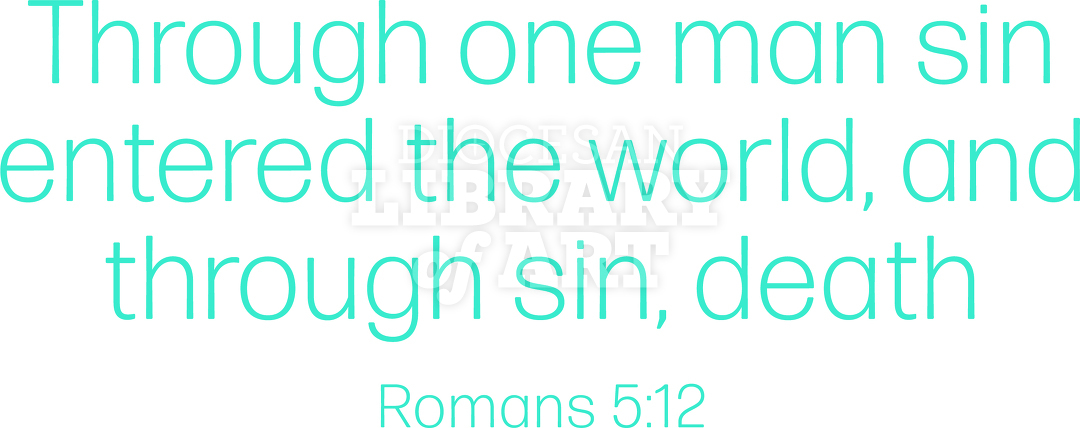
In the annals of biblical scripture, few narratives resonate as profoundly as the account of humanity’s inception and the subsequent fall from grace, captured succinctly in the phrase “By one man’s disobedience, sin entered the world.” This theological assertion, located primarily within the Pauline epistles, particularly Romans 5:12, serves as a fulcrum for discourse surrounding sin, responsibility, and the human condition. Through the lens of cultural relativism, an examination of this doctrine can unveil intricate layers of meaning, reflecting varying interpretations across diverse societies throughout history.
To embark upon this exploration, one must first establish a foundational understanding of the biblical account itself. The narrative, rooted in the creation story recounted in the Book of Genesis, positions Adam and Eve in a pristine Eden, endowed with free will. The disastrous decision to transgress divine command is presented not merely as an isolated act of disobedience but as a pivotal moment that irrevocably altered the trajectory of human existence. Theologically, this act introduces the concept of original sin—a notion positing that the repercussions of this singular disobedience extend beyond the immediate actors to influence their progeny.
From a cultural relativism standpoint, this biblical narrative does not exist in a vacuum. Instead, it’s imperative to analyze how varying cultural contexts interpret sin and disobedience. In societies where collectivism is prized over individualism, the emphasis may shift from the act of Adam alone to the implications that his actions have on the communal identity. This shift invites questions about shared responsibility and collective guilt, contrasting Western interpretations that often prioritize individual agency and moral accountability.
Within different cultural frameworks, the portrayal of Adam transcends mere historical figure; he embodies archetypal roles that various societies grapple with to articulate their existential dilemmas. For instance, in numerous indigenous traditions, the concept of a ‘fall’ may conjure different associations tied to personal and ecological harmony. In this context, the Terran relationship—humans with nature—may be seen as disrupted not merely by disobedience but by a deeper cultural failure to maintain equilibrium. Such a perspective prompts an inquiry into how societies negotiate their understanding of transgressions against both divine and natural laws.
The implications of this narrative extend into the cultural fabric where notions of sin and morality are intricately woven. For instance, in cultures that espouse a cyclic understanding of time and existence, the linear progression of sin may be at odds with beliefs in rebirth or renewal. Here, the idea of sin as inherently detrimental diminishes, allowing narratives of redemption and rebirth to flourish alongside those of disobedience and fallibility. This invites an exploration of how religious narratives are adapted and reinterpreted to address the needs and values of varying cultural contexts.
Moreover, the discourse surrounding sin in the realm of gender relations also warrants scrutiny. The traditional interpretation frequently casts Eve in a light of culpability, branding her as the harbinger of sin through her decision to consume the forbidden fruit. Such interpretations reflect and reinforce patriarchal paradigms prevalent within various societies. Analyzing this through a cultural relativist perspective reveals that different cultures may either perpetuate or challenge these gendered views. In some societies, female figures may be heralded for their wisdom and autonomy, recontextualizing the narrative of disobedience as an act of agency rather than mere rebellion against divine command.
Furthermore, the idea of sin as articulated in Romans manifests diversely when examined through the prism of ethical frameworks beyond the Christian paradigm. For example, in Eastern philosophies such as Buddhism, the concept of ‘sin’ differs significantly. Rather than an inherited state from a singular act of disobedience, suffering is interpreted as an inevitable aspect of life, a condition arising from ignorance and attachment. This divergence in understanding prompts critical reflections on the universality of concepts such as sin and redemption. In doing so, it raises profound questions: Is sin an absolute condition, or is it, as cultural relativism suggests, a construct shaped by the mores and ethos of particular societies?
As the conversation deepens, it is essential to consider the role of modernity and global interconnectedness in re-evaluating these ancient texts. In a world increasingly characterized by cultural pluralism, the static interpretations of sin and disobedience are being reframed and renegotiated. Technology, migration, and intercultural dialogues facilitate a tapestry of beliefs that coexist and interact, often leading to new hybrid understandings of age-old narratives. The biblical tale of Adam and Eve, juxtaposed against contemporary moral quandaries, beckons a re-imagination of original sin and personal responsibility in the face of current ethical challenges, such as environmental degradation and social injustice.
The pivot from a traditional to a relativistic understanding of “By one man’s disobedience, sin entered the world” not only promises a radical shift in perspective but invites a nuanced dialogue about accountability and redemption. By embracing cultural relativism, scholars and practitioners alike can better appreciate the rich tapestry of human interpretations—each exposing differing facets of the human experience and prompting curiosity about the shared values and disparities that define the global community.
What remains resonant, however, is the underlying inquiry into the nature of disobedience itself. It is not merely the act that defines humanity’s struggle with sin, but rather the endlessly multifaceted interpretations and repercussions that arise from such acts. As discourse evolves, the question remains: Can humanity reconcile the dichotomy of sin and redemption across its diverse cultural landscapes? Through continued exploration, one can hope to glean understanding not just of the narratives that shape beliefs but of the very essence of the human spirit.