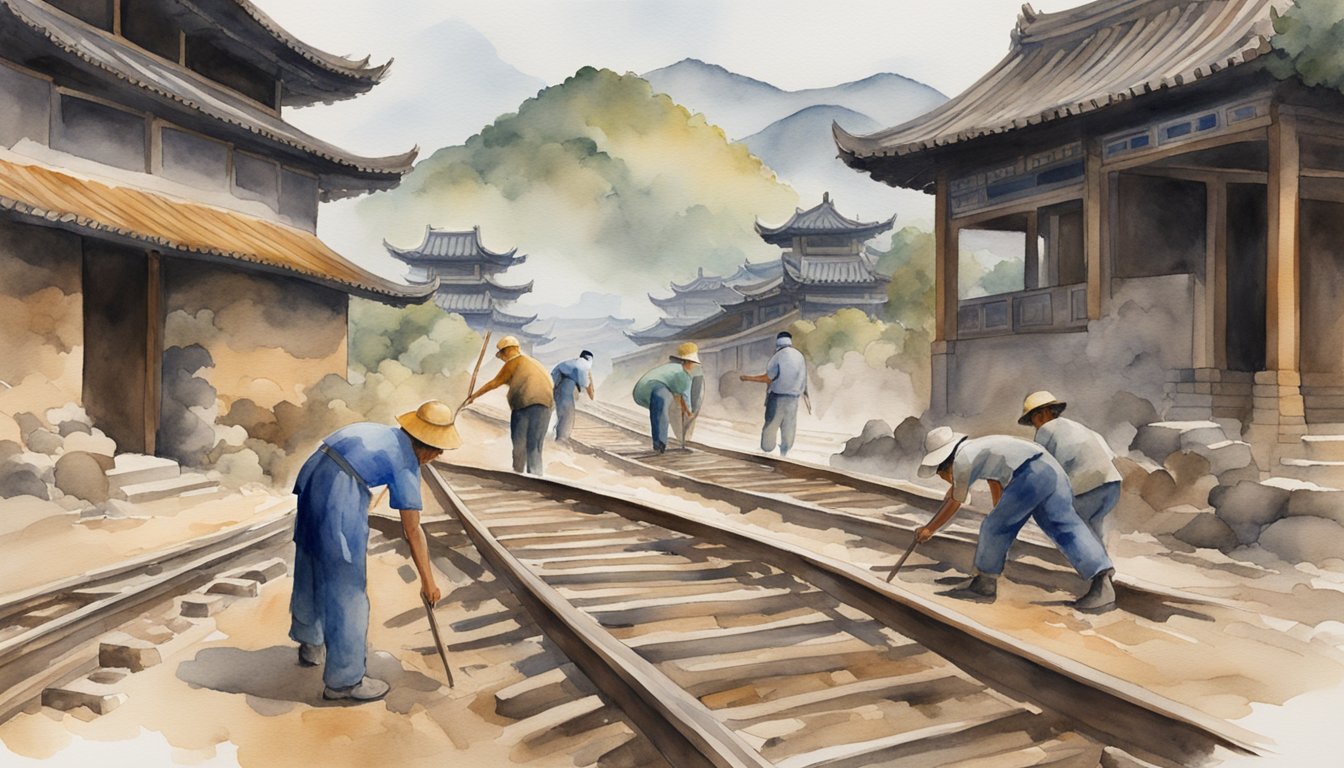
The construction of the Transcontinental Railroad stands as a monumental event in American history, representing not only a feat of engineering but also a complex social tapestry woven from the contributions and sacrifices of diverse groups, particularly Chinese laborers. This discussion centers on cultural relativism, a framework that emphasizes understanding a culture’s beliefs, practices, and contributions within its own context, rather than judging it against external standards. When applied to the experiences of Chinese workers on the Transcontinental Railroad, this perspective unveils the depth of their pivotal role in shaping American infrastructure and, ultimately, its economic landscape.
The Transcontinental Railroad, completed in 1869, was heralded as a monumental achievement, connecting the eastern United States to the Pacific coast. This integration fostered unprecedented economic growth and mobility. However, among the individuals whose labor made this dream a reality, Chinese workers formed a significant portion. Appraised through the lens of cultural relativism, their involvement reveals a narrative rich in resilience and societal contribution, often overlooked in mainstream historical recounting.
Initially, it is essential to understand the socio-political context from which these laborers emerged. Following the Gold Rush of 1849, Chinese immigrants surged into the United States. Facing discrimination and limited opportunities, many turned to labor-intensive occupations. The Central Pacific Railroad Company, recognizing the desperation and skills of these workers, recruited them en masse. This recruitment was not merely a transaction; it was a lifeline. For many, it represented the hope of economic stability and the possibility of prosperity.
The labor dynamics within the construction of the Transcontinental Railroad necessitated an appreciation of the deep-seated cultural practices and communal structures maintained by the Chinese workers. Contrary to the prevalent Eurocentric perspective that often highlights individualism and capitalist meritocracy, Chinese laborers operated within collectivist frameworks that emphasized community, interdependence, and shared goals. Their approach to work was imbued with values derived from Confucian ethics, highlighting diligence, loyalty, and perseverance.
Working under harrowing conditions, Chinese workers faced numerous challenges, including treacherous terrain, perilous weather, and racially motivated hostility. More than mere physical laborers, they were architects of a narrative fraught with struggle and endurance. Cultural relativism provides an analytical lens through which one can interpret their attempts to navigate a foreign landscape while maintaining their cultural identity through familial networks, linguistic ties, and social rituals.
The significance of Chinese laborers transcended the mere physical act of laying tracks. Their contributions catalyzed the evolution of labor practices not only within the railroad industry but across other sectors in the United States. In employing innovative techniques and approaches such as the use of gunpowder for blasting through mountains, these workers exemplified ingenuity that was rooted in their experiences and cultural context. Such practices were not simply adaptations to American methodologies but represented the fusion of Eastern and Western engineering principles, manifesting a form of cultural synergy.
Moreover, the imposition of laborious conditions and systemic discrimination reflects an unfortunate irony within the mythos of the American Dream. While the railroad facilitated the migration of settlers and promoted individual success, it simultaneously marginalized those who were integral to its construction. The cultural relativist perspective elucidates these contradictions by highlighting how Chinese workers were often relegated to the periphery of the American narrative, despite their tangible contributions.
Furthermore, the treatment of Chinese laborers mirrored broader societal attitudes toward immigrants and minority groups in America. Cultural relativism prompts a critical examination of these attitudes. It urges us to question the ethics of labor practices and the value assigned to different populations based on prevailing social hierarchies. For instance, despite the vital role these workers played in building the nation, they were frequently subject to discriminatory wages, unsafe working conditions, and social ostracism.
Within this framework, it becomes evident that the struggle of Chinese workers on the Transcontinental Railroad is not merely a footnote in history, but rather a lens through which to view broader themes of resilience, equity, and recognition. Understanding their plight through cultural relativism allows for a more nuanced discourse about contributions that are often rendered invisible in dominant narratives. It challenges the audience to reconsider the parameters of what constitutes merit and achievement, particularly in a society that continues to grapple with racial inequalities.
Post completion of the railroad, the legacy of Chinese workers evolved, illustrating the intricate intersection between history and policy. Initially hailed for their labor, they subsequently faced exclusionary laws, such as the Chinese Exclusion Act of 1882, which reflected an alarming shift in public sentiment. This legislation underscores the necessity of viewing history through a cultural lens that recognizes the cyclical nature of acceptance and rejection, inclusion and exclusion, as intrinsic to the American experience.
In conclusion, the story of Chinese workers on the Transcontinental Railroad is emblematic of a broader human experience marred by both triumph and tragedy. Employing cultural relativism fosters a deeper understanding of their contributions as foundational elements of American society. It implores contemporary audiences to acknowledge the multiplicity of narratives that comprise our collective history, and to honor the disparate voices that echo through time. As we traverse the landscape of history, it is imperative to recognize the laborers who made the dream of the railroad a reality, underscoring their invaluable role in the fabric of American progress.