Short Answer
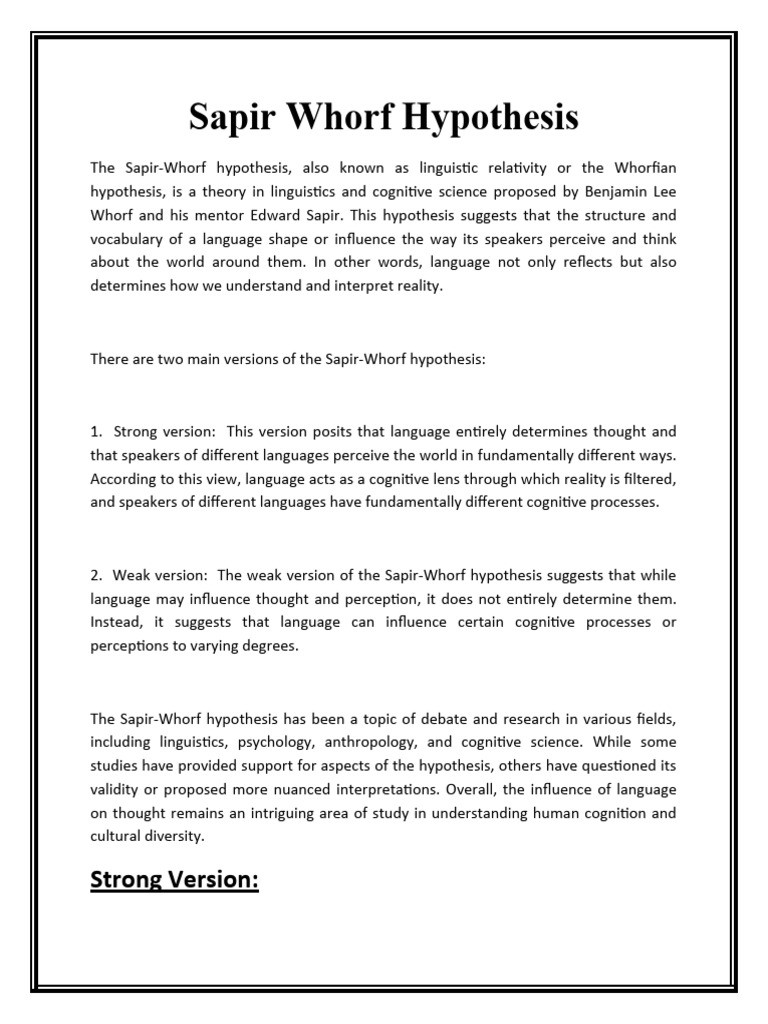
The Sapir-Whorf Hypothesis, also known as linguistic relativity, posits that the structure and vocabulary of a language influence its speakers’ worldview and cognition. This intriguing concept, named after linguists Edward Sapir and Benjamin Lee Whorf, is compelling not only in the field of linguistics but also in psychology, anthropology, and even environmental studies. This document outlines key elements related to the hypothesis, providing multifaceted insights into its implications, applications, and the scholarly discourse surrounding it.
At its core, the Sapir-Whorf Hypothesis can be divided into two primary propositions: the strong version and the weak version. The strong version, often referred to as “linguistic determinism,” asserts that language constrains thought, suggesting that speakers of different languages may indeed perceive and interact with the world in fundamentally disparate ways. In contrast, the weak version posits that language influences thought without outright limiting it. This understanding is critical in exploring the ways in which various languages frame experiences and shape not only individual cognition but collective cultural identities.
For those delving into the intricacies of this hypothesis through a PDF format study, several key aspects and themes may surface:
- Historical Context: An exploration of the historical evolution of the Sapir-Whorf Hypothesis reveals its roots in early 20th-century linguistics. The initial work by Edward Sapir emphasized the link between language, culture, and thought patterns. Whorf, in his later explorations, presented specific examples from Native American languages to illustrate how language structure could steer cognition and societal values.
- Language and Perception: The relationship between language and perception is pivotal in understanding the Sapir-Whorf Hypothesis. Researchers have investigated how various grammatical structures and lexical choices can shape interpersonal interactions and individual perceptions of the environment. For example, in languages that exhibit nuanced vocabularies for colors or relationships, speakers may inherently develop a more sophisticated awareness of those concepts.
- Empirical Studies: Numerous empirical studies have sought to test the validity of the hypothesis. Some studies have supported the idea that language can affect thought processes, leading to different interpretations of reality among speakers of distinct languages. However, the outcomes have not always been conclusive, prompting ongoing debate about the extent of linguistic influence.
- Cultural Implications: The hypothesis provides a lens through which to examine cultural differences. As it relates to behaviors, customs, and even social hierarchies, language acts as a vessel for cultural norms. An analysis of how indigenous groups articulate concepts of nature and sustainability can offer profound insights into their environmental perspectives and practices.
- Environmental Discourse: Upon considering the implications of the Sapir-Whorf Hypothesis in environmental contexts, one can explore how the language used in ecological discussions shapes public perception and policy-making. The terminology employed in climate change discourse can either foster urgent action or engender apathy, demonstrating the undeniable power of language in shaping environmental attitudes.
- Case Studies: Real-world case studies related to the Sapir-Whorf Hypothesis abound, illustrating its principles across various cultural and linguistic communities. Analyzing how different cultures articulate concepts of time, space, and ecological stewardship provides valuable insight into their respective environmental conservation efforts. In regions where languages emphasize the interconnectedness of all living beings, one may observe a heightened awareness of ecological sustainability.
- Critiques and Counterarguments: The Sapir-Whorf Hypothesis has not been immune to critique. Scholars have raised valid concerns about the methodology and interpretative frameworks of studies supporting linguistic relativity. Discussions surrounding the hypothesis encourage an examination of cognitive universals and the potential overemphasis on linguistic distinctions. Addressing these critiques is fundamental for those intending to engage critically with the hypothesis.
- Future Directions: The future of research related to the Sapir-Whorf Hypothesis appears promising, particularly with growing advances in cognitive science and neuroscience. As technology enhances our capacity to scrutinize the neural underpinnings of language processing, researchers will continue to gain insights into the intricate relationships between linguistic structures and human cognition. Future investigations may pave the way for novel applications, especially where language intersects with urgent global challenges, such as climate change.
- Conclusion: The Sapir-Whorf Hypothesis remains a significant area of inquiry that interlinks numerous disciplines. The perspectives it offers are invaluable, revealing the profound implications of language in shaping thought, culture, and societal values. As discourse around climate change escalates, understanding the linguistic dimensions of environmental discussions could lead to more effective engagement strategies. This hypothesis invites a continuous exploration of the intricate tapestry of human language and its capacity to influence our understanding of the world.
In conclusion, diving into the literature and research surrounding the Sapir-Whorf Hypothesis via a PDF document can yield a deep reservoir of knowledge. This exploration encompasses historical background, theoretical frameworks, empirical research, and its ramifications for contemporary issues, including environmental consciousness. Such a multifaceted examination ensures a comprehensive grasp of the subject, illuminating the indispensable role language plays in shaping our collective reality.
FAQ
What is the Sapir-Whorf Hypothesis?
It is the theory that language influences or determines the way its speakers think and perceive the world.
What are the two main versions of the Sapir-Whorf Hypothesis?
The strong version, or linguistic determinism, claims language constrains thought, while the weak version suggests language influences thought without fully limiting it.
How has the Sapir-Whorf Hypothesis been tested?
Through empirical studies examining how speakers of different languages perceive colors, time, space, and cultural concepts differently, though results remain debated.
What are some critiques of the Sapir-Whorf Hypothesis?
Critiques focus on methodological issues, overemphasis on linguistic differences, and the existence of cognitive universals that transcend language.
Why is the Sapir-Whorf Hypothesis relevant to environmental studies?
Because language shapes how societies perceive and discuss nature and sustainability, influencing environmental attitudes and policies.
Leave a Reply